Sustainability

We are committed to playing our part in supporting the transition to a zero-carbon economy. This is a strategic priority for VBB. We aim to achieve a 50% reduction of our carbon emissions, from a 2019 baseline, by 2030.
Our approach
We follow the GHG Protocol Corporate Standard, developed by the World Business Council for Sustainable Development (WBCSD) and World Resources Institute (WRI).
This standard describes how to track emissions for the six greenhouse gases (GHGs) (Carbon dioxide (CO2), Methane (CH4), Nitrous Oxide (N2O), Hydrofluorocarbons (HFCs), Perfluorocarbons (PFCs), and Sulphur Hexafluoride (SF6)).
We track and report sources of carbon emissions falling within three scopes:
1
Direct GHG emissions from sources VBB owns or controls, including on-site stationary fuel combustion, heating or cooling equipment.
2
Indirect GHG emissions from purchased energy emitted by a third party that is consumed by VBB.
3
Indirect emissions related to VBB’s activities, but occurring from sources not controlled by us (such as within the supply chain due to activities of suppliers or clients, air travel, business travel in personal vehicles, rail travel, etc.)
See our carbon reduction plans published in 2024 and 2025.
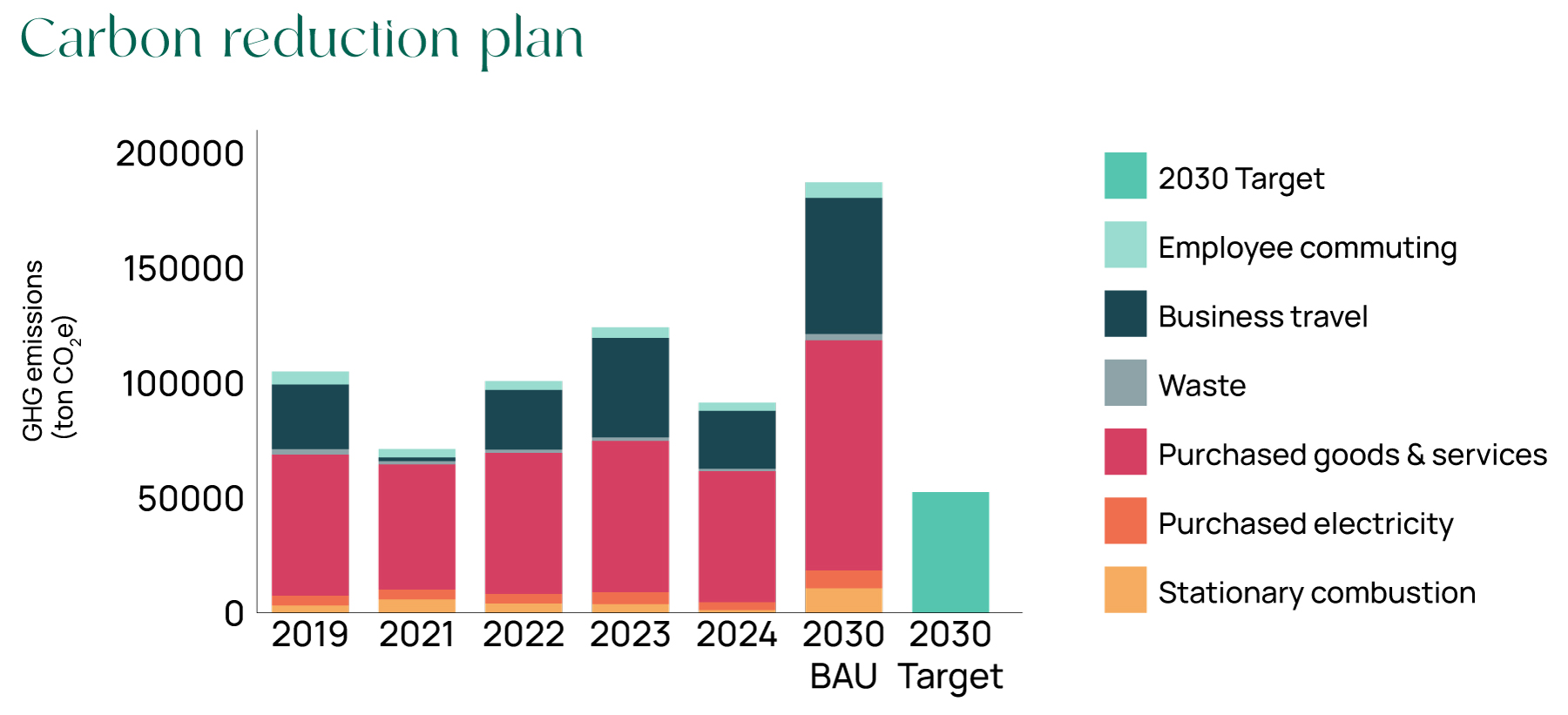
We continuously review and aim to reduce our carbon emissions through better data collection and reporting and targeted actions. We build awareness and positive action through internal campaigns and training.
Actions we have taken to date include:
- Transition from traditional lighting to energy-efficient LED lights to reduce electricity consumption.
- Implementation of a structured recycling programme for printing toners and other office supplies to minimise waste.
- Offsetting carbon emissions from all business-related travel through verified compensation programmes (via our external travel agency).
- Efforts to switch to renewable energy sources for office operations, dependent on building management approval.
- Adoption of recycled materials for office supplies and branded materials to lower environmental impact.
- Requesting proof of sustainability practices from suppliers to ensure responsible sourcing and procurement.
Priorities
Future priorities include:
- Selection of tier 1 suppliers with carbon reduction plans and/or adhering to science-based targets.
- Reduction of consumption of high-carbon products and services.
- Encouragement of use of economy class for long-distance business travel and further reduction of travel.
- Promotion of electric vehicle/public transport and bike for commuting of employees.
- Sourcing of renewable electricity in all offices that we lease.